AI Agents vs. AI Workflows: What’s the Difference and Why It Matters

Author: Zahra Hassan
The rapid evolution of AI is putting us all on the edge, making the future totally unpredictable and revolutionary. What AI could do now compared to just a month ago is beyond comprehension. According to Business Times, AI startup funding hit a record US$97 billion in 2024! No wonder the tech industry is advancing at such a faster pace introducing new features and announcements almost everyday!
As you may have heard the recent talks on the developments of AI agents, businesses are now trying to implement AI agents in their daily operations to improve efficiency and rely less on human intervention. But how reliable are they? Will they surpass the workflows and automation tools businesses have relied on for decades? What’s the difference between AI agents and AI workflows? Do we really need AI agents to run our businesses?
Let’s break it down and find out.
What are AI Workflows?
Before we go into AI Workflows, let’s take a look at what an automation workflow is.
Automation workflow has been everywhere for decades in the businesses. They are predefined, rule-based tasks set to be done automatically without human inputs. They are mainly for repetitive and predictable tasks to keep the system running smoothly and consistently.
| Benefits | Limitations |
| 🢡 Quick implementation with existing tools. 🢡 Cost-effective. 🢡 Fast and efficient. 🢡 Ideal for rule-based repetitive tasks. 🢡 Clearly-defined outputs. | 🢡 Limited to predefined tasks only. 🢡 Can’t adapt to new variables. 🢡 Not suitable for complex tasks. |
Now let’s see how AI workflows function. They work the same way, but with AI capabilities where a language model like ChatGPT is integrated into the system to perform a set of predefined rules to make the process more flexible and adaptive.
| Benefits | Limitations |
| 🢡 Ideal for handling tasks requiring complex rules. 🢡 Great for pattern recognition and unstructured inputs. 🢡 Adapts based on new inputs. 🢡 Facilitates personalized automation. 🢡 Makes automation smarter with AI insights. | 🢡 Requires data and training. 🢡 Still relies on predefined paths for overall execution. 🢡 Difficult to debug and interpret. |
Here’s an easy-to-understand example:
Applicant submits his resume via a website.
This is how an Automation workflow looks like:
- Scans for keywords like “Python”, “5 years experience”, etc.
- If keywords match, send it to the hiring manager.
- If no keywords match, send a rejection email immediately.
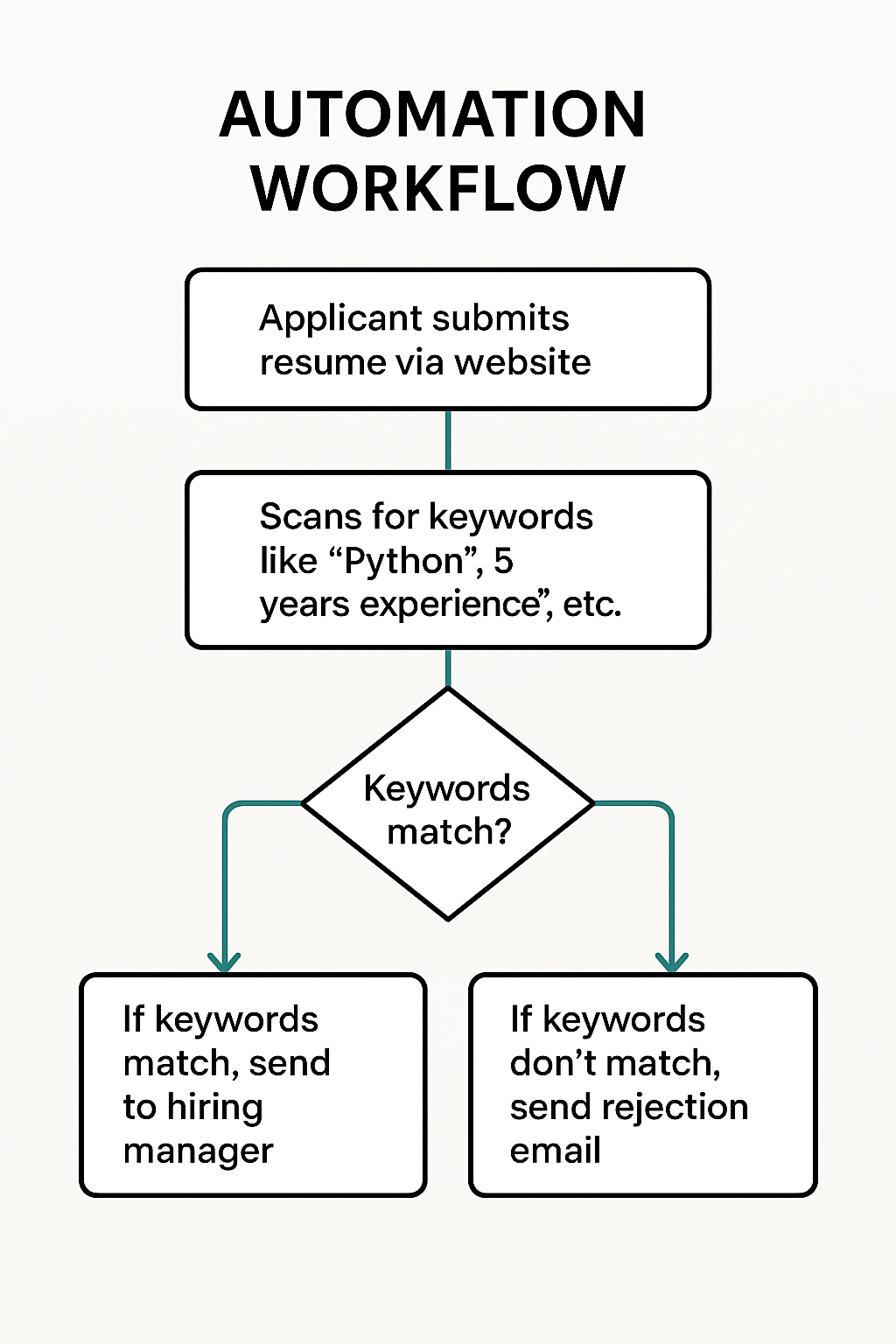
Now let’s see what happens to the above automation workflow when we integrate AI into the system, making it an AI workflow:
Applicant submits his resume via a website.
- AI reads and understands the resume by detecting skills and experience, not just keywords.
- Examples: AI categorizes “built APIs” as Python experience.
Comparing role relevance like managed team vs. individual contributor. - Predicts how the candidate fits into the role by scoring based on success traits and past hires.
- If the applicant has an outstanding score, send it to the hiring manager. Otherwise, a rejection email.
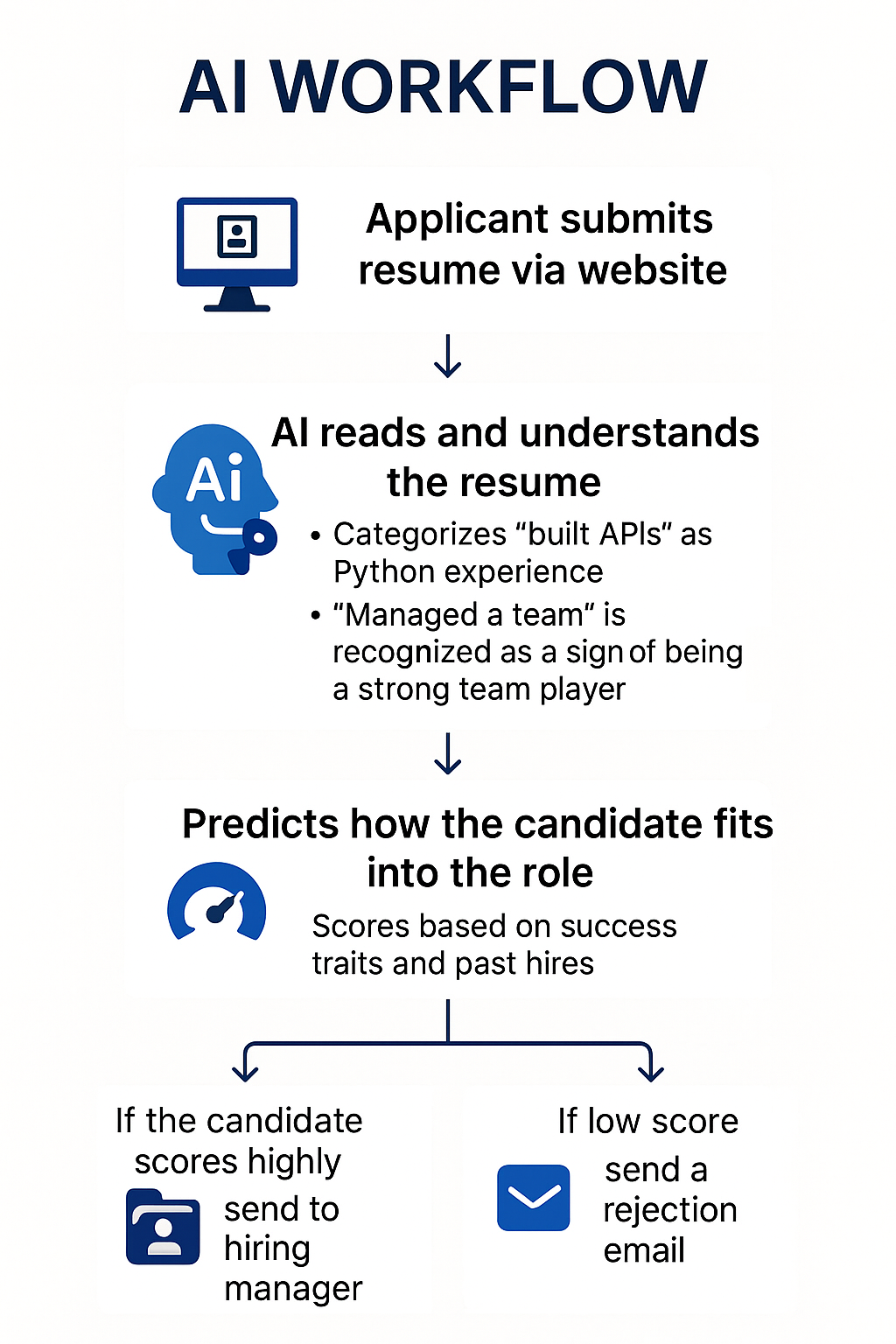
As you can see, AI Workflow is not just about automation, it also improves decisions and makes automation smarter with AI insights.
| Feature | Automation Workflows | AI Workflows |
| Decision Making | Rule-based only | Rule-based, but AI driven & adaptive |
| Data Handling | Structured data only | Structured and unstructured data (preprocessing required for AI steps) |
| Flexibility | Rigid structure | Dynamic adjustments possible |
| Implementation | Faster to set up | Easy to set up, but requires data to train models |
| Cost | Generally lower | Low to moderate (scales with AI features) |
What are AI Agents?
AI Agents are software programs designed to work independently based on its understanding of data inputs or triggers, to accomplish the goals set by humans.
Unlike AI Workflows, AI agents are capable of learning, adjusting, improving, and making decisions based on context and outcomes to choose the best action to perform and achieve the goals without relying on predefined rules.
To make it more understandable, here’s a comparison table showing the difference between AI Workflows and AI Agents.
| Feature | AI Agents | AI Workflows |
| Decision Making | Autonomous | Rule-based, but AI driven & adaptive |
| Interaction | Engages in real-time conversations | Executes tasks without direct interaction |
| Data Handling | All types of data and learns continuously from interactions (no preprocessing required) | Structured and unstructured data (preprocessing required for AI steps) |
| Complexity | Handles open-ended tasks | Best for deterministic tasks |
| Flexibility | Highly Adaptive | Dynamic adjustments possible |
| Implementation | Complex, as it requires training models, NLP, memory, tools and multi-agent systems | Easy to set up, but requires data to train models |
| Cost | High (custom AI development, cloud APIs, maintenance, etc.) | Low to moderate (scales with AI features) |
| Benefits | Limitations |
| 🢡 Autonomous: Operates on its own. No human intervention required. 🢡 Highly adaptive: Learns and evolves overtime from feedback and outcomes to new situations. 🢡 Goal-driven: Design to accomplish specific goals without any predefined rules. 🢡 Interactive: Engages in real-time conversations. Exhibits human-like behavior and reasoning. 🢡 Complex problem-solving: Can handle uncertainty and complex challenges by combining different skills and strengths. | 🢡 Possibility of producing unpredictable outputs depending on the data quality. 🢡 Not ideal for limited budgets since it requires significant resources to develop and deploy AI agents, and takes time to execute. 🢡 Difficult to debug and improve since they make decisions on their own. |
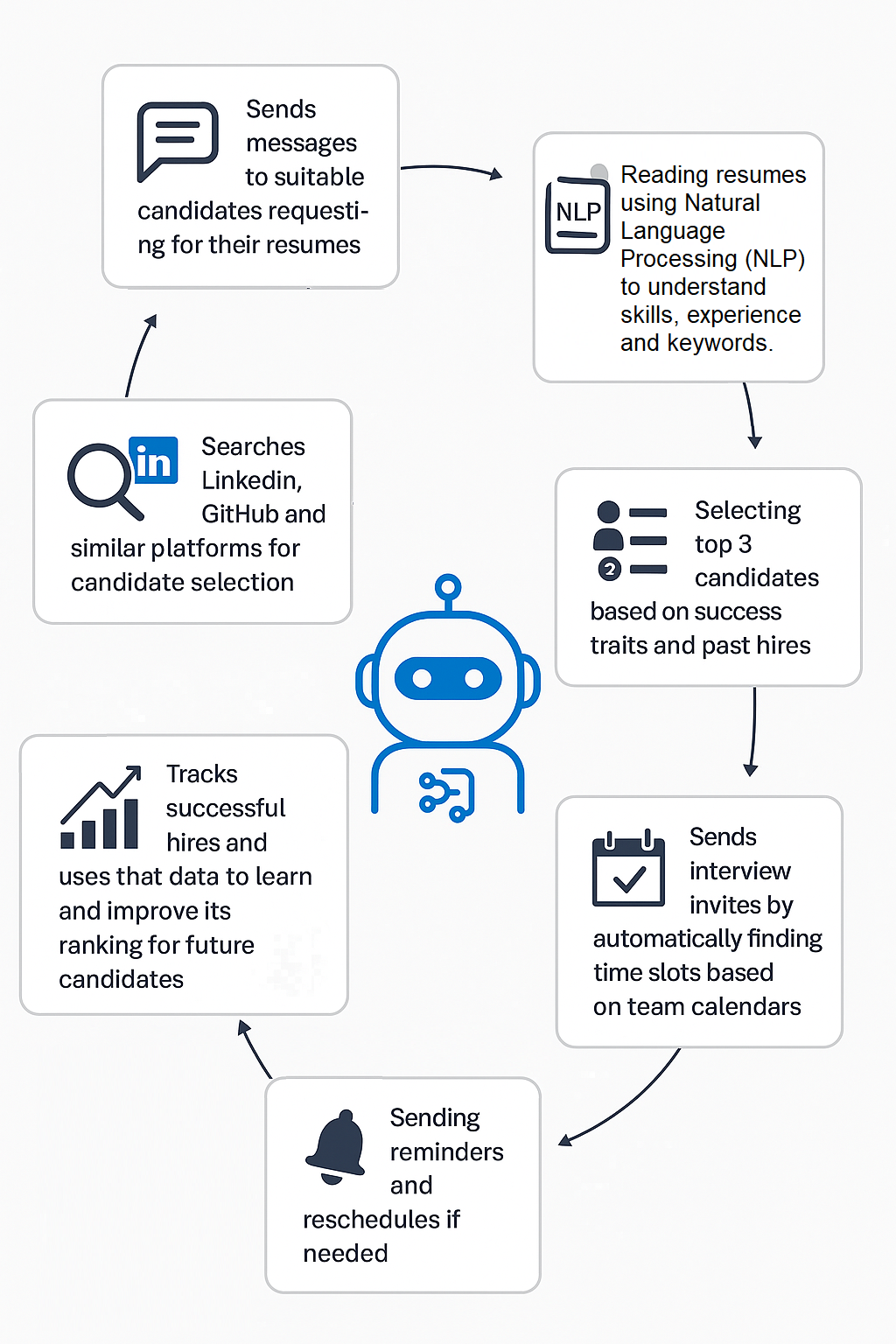
Now let’s take the same example we used before for Automation Workflow and AI Workflow. The entire HR role is handled by an AI agent, eliminating the need for job postings.
Here’s how it works:
- Searches LinkedIn, GitHub and similar platforms for candidate selection.
- Sends messages to suitable candidates requesting for their resumes.
- Reading resumes using Natural Language Processing (NLP) to understand skills, experience and keywords.
- Selecting top 3 candidates based on success traits and past hires.
- Sends interview invites by automatically finding time slots based on team calendars.
- Sending reminders and reschedules if needed.
- Tracks successful hires and uses that data to learn and improve its ranking for future candidates.
Why it is more than just a workflow
- Makes decisions on its own by choosing top candidates.
- Understanding inputs by reading candidates’ resumes.
- Works on its own by running tasks without human intervention.
- Learns and improves from data and outcomes for future candidates.
AI Workflows vs. AI Agents: Why the Difference Matters?
Now you have a good understanding about how AI workflows and AI agents work, but the real question is, when to use which?
Here’s where the distinction matters, to help choose the right tool for the right job.
Obviously, the answer comes down to which problem you are trying to solve. If it is about a specific task or process, then AI workflows would work just fine. But if you want to streamline an entire job or function, then AI agents are something to consider.
Assess your specific use case and needs. If it’s impossible to automate using AI workflows and requires human intervention or judgement, it is best to equip AI agents to achieve successful outcomes.
If you are looking for AI solutions for your business and need help to evaluate your processes for automation, we are here to help. Just drop us a comment or submit your details here for a free call.

WBC Digital Solutions
Book a Consultation
Ready to take the next step? Schedule a consultation with our expert team.
Explore Related Topics
Other Articles

Digital Twins + AI: The Future of Smart Manufacturing and Operations
Let's explore how Digital Twins powered by AI are redefining the future of smart manufacturing.
Read more →
WBC Digital Partners with Great Wall Connect to Unlock China’s Digital Market
WBC Digital is partnering with Great Wall Connect to deliver end-to-end digital solutions for companies expanding into China.
Read more →
How E-Commerce Businesses Can Leverage Data to Maximize Sales This Chinese New Year
Let's explore how you can use your data to maximize sales in Chinese New Year.
Read more →