How AI & IoT Are Transforming Utility Management in Smart Cities

Author: Zahra Hassan
The concept of smart cities is no longer something futuristic, as it’s already here, thanks to AI and IoT. From traffic systems to utility management, everything can be managed with just a few clicks or even without any clicks to streamline the operations, unlocking the full potential of smart cities.
But what exactly is a smart city? How AI & IoT are playing a critical role in redefining urban living? What are the benefits and challenges? That’s what we are going to discuss and more in this article today.
What is a Smart City?
According to the World Bank, more than half of the population, that is over 4 billion people, are currently living in cities. This figure is expected to double by 2050 where for every 10 people, 7 will be living in cities! No wonder urbanization is becoming more and more prevalent today.
The stats above show the need for advanced technologies in cities that can provide innovative solutions for transportation, infrastructure, utilities, healthcare, etc. using AI and IoT, where the needs of people are met in real-time, making cities more efficient, sustainable, and livable. And this is what we call a smart city.
Why Are AI & IoT Essential for Smart Cities?
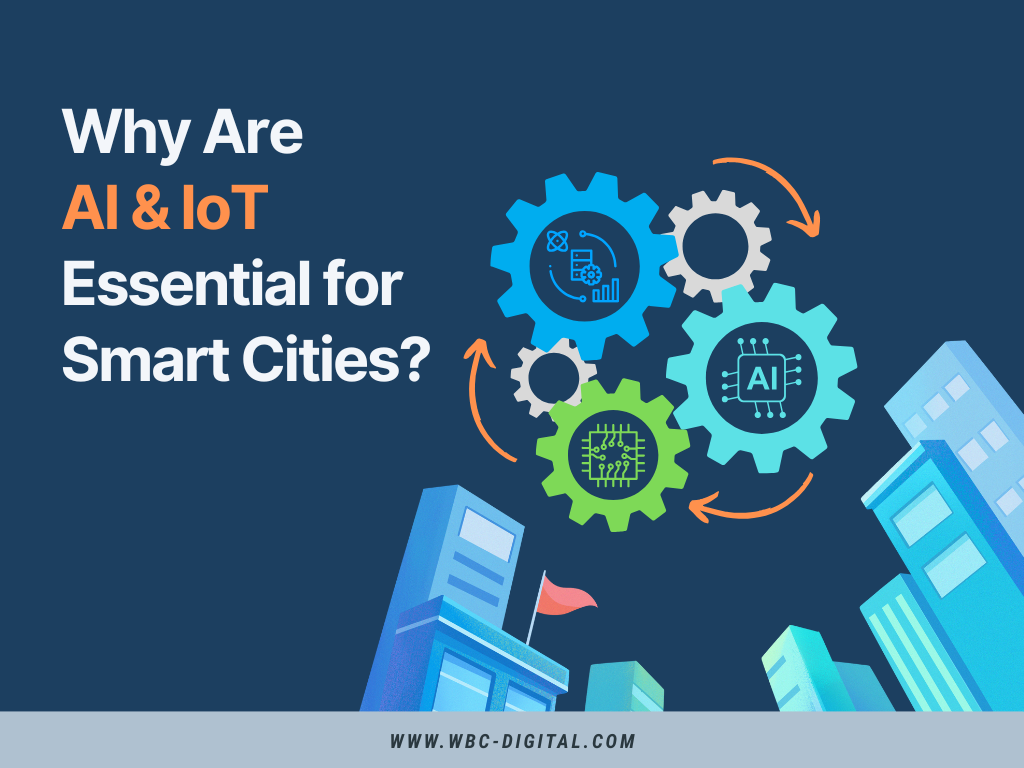
In order to develop a smart city, we need data to gain insights to improve the services and make data-driven decisions. However, it will take forever for humans to analyze and interpret vast amounts of data to determine the right course of actions.
This is where AI & IoT come into play making smart cities a reality, where IoT will gather all kinds of data, and AI will convert that data into actionable insights to optimize operations and improve urban living.
Let’s break it down to make it more clear and give you an idea on how it all works:
- Installation of IoT Devices or Sensors:
This is the first step, as we need data to improve the services. This means, installing IoT devices or sensors to gather data on transportation, energy, utilities, etc. - AI Integration for Data Analytics:
The second step is to integrate/facilitate AI into these IoT devices or sensors, so they can convert and analyze large amounts of data in real time to identify patterns and offer proactive solutions to help authorities make data-driven decisions. - AI Automation & Real-time Action:
The final step is AI automation that enables systems to use their analysis in real-time to automatically take the most appropriate actions without human intervention. What’s more impressive is that these systems continuously learn from the outcomes of their actions, allowing them to make smarter decisions and improved adjustments over time.
As you can see from the above, building smart cities is just a myth without AI and IoT, as they play a crucial role in developing smart technologies for real-time urban solutions.
Smart Utilities, Smarter Cities
If you want smart cities to become smarter, you need smart utilities. 🙂 No matter how advanced a city is, without proper utility management, the city cannot function, as the foundation of every city lies in its utilities such as: energy, water, gas, and waste management.
So what are smart utilities? Smart utilities are equipped with sensors, AI integration, and digital platforms to monitor and optimize the essential resources such as: energy, water, gas and waste. If you want smart cities to become sustainable, efficient, and livable; you need smart utilities.
Let’s see how AI & IoT are playing a critical role in utility management in smart cities.
- Energy Efficiency Leads to Economic Efficiency
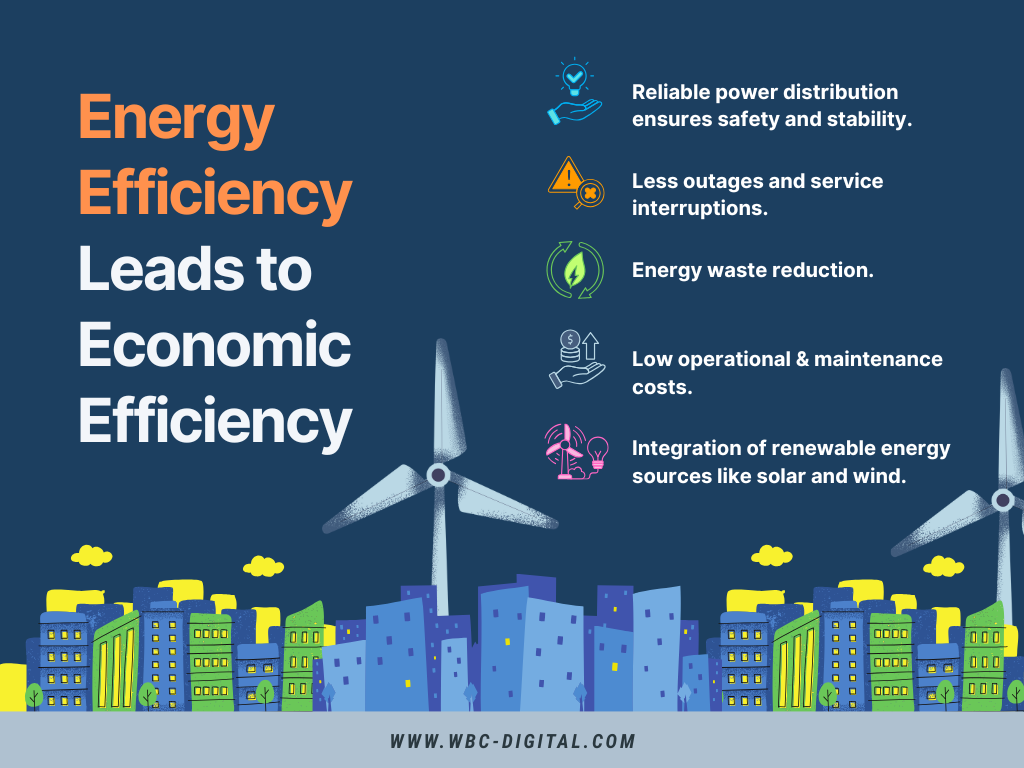
From streetlights, to houses to skyscrapers, energy powers everything. If we want to achieve economic efficiency which is a key ingredient for smart cities, we need efficient energy management to continuously monitor and optimize the energy flow. That’s why power companies in smart cities use AI and IoT for grid optimization by integrating sensors and AI automation in power lines, transformers, and substations. This allows them to integrate renewable energy sources, effectively manage load balancing and outage responses, and detect any early signs of failures while also minimizing energy waste.
For example: if there’s a surge of power usage in an area, AI can automatically redistribute power from low-demand zones to prevent power outages.
It is also surprising to hear that around 30% of energy is being wasted in commercial buildings. That’s why commercial spaces in smart cities implement smart technologies using AI and IoT to eliminate energy waste, reduce emissions, and unnecessary costs. A simple example is automatically turning off lights when the room is empty or monitoring the temperature of a room and automatically adjusting it accordingly. Envision Charlotte saved around $10 million using IoT solutions over 70 buildings. That’s an 8.4% reduction in energy use based on their estimation.
Our latest collaboration with FireAlert Faczilla, where we built automation systems to monitor their smart building operations, marks a significant step towards smarter, energy-efficient infrastructure. If you are interested, you can learn more about the project here: https://www.wbc-digital.com/projects/firealert.html
Key outcomes:
– Reliable power distribution ensures safety and stability.
– Less outages and service interruptions.
– Energy waste reduction.
– Low operational and maintenance costs.
– Supports integration of renewable energy sources like solar and wind.
- Smart Water Systems Promote Sustainability
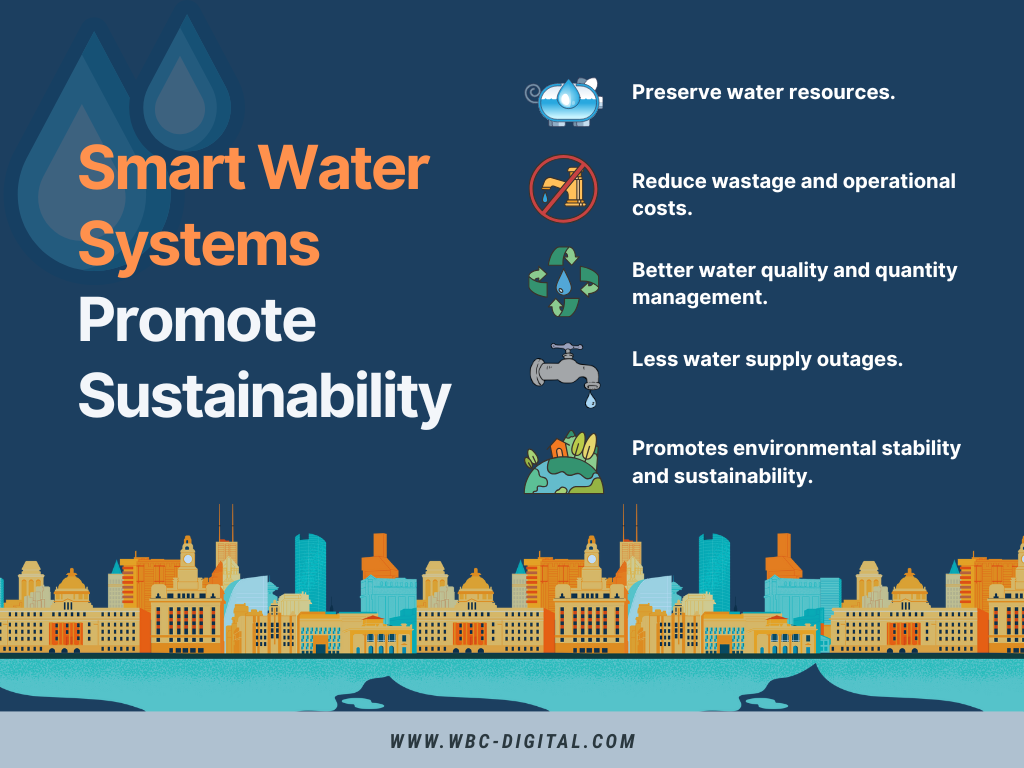
According to Discover Water, in the UK alone, 3 billion litres of water are being lost daily due to leaky pipes. That’s a very costly amount which if prevented, can save tons of money and water for both residents and companies. No wonder it is one of the most mismanaged urban resources.
In smart cities, this issue is being tackled by installing smart meters that allow IoT sensors to monitor the water usage in real time. Combined with AI, these meters can detect any leakages or potential issues with great precision, allowing the authorities to take action before it leads to costly issues. Tokyo is a great example, as it has one of the lowest water leakage rates at 2%, thanks to its efficient smart water systems.
One of our recent works is also a best example for this use case, where we built an entire digital platform for Hyele Ltd. to monitor their smart urban water pipeline systems. If you would like to learn more about how we helped them build a centralized digital platform for real-time monitoring, you can read our case study here: https://www.wbc-digital.com/projects/hyele.html
Smart water systems are not just about surviving water challenges, it’s more about environmental stability and long-term livability.
Key outcomes:
– Preserve water resources.
– Reduce wastage and operational costs.
– Better water quality and quantity management.
– Less water supply outages.
– Promotes environmental stability and sustainability.
- Smart Gas Utilities & Waste Management for Cleaner, Safer Cities
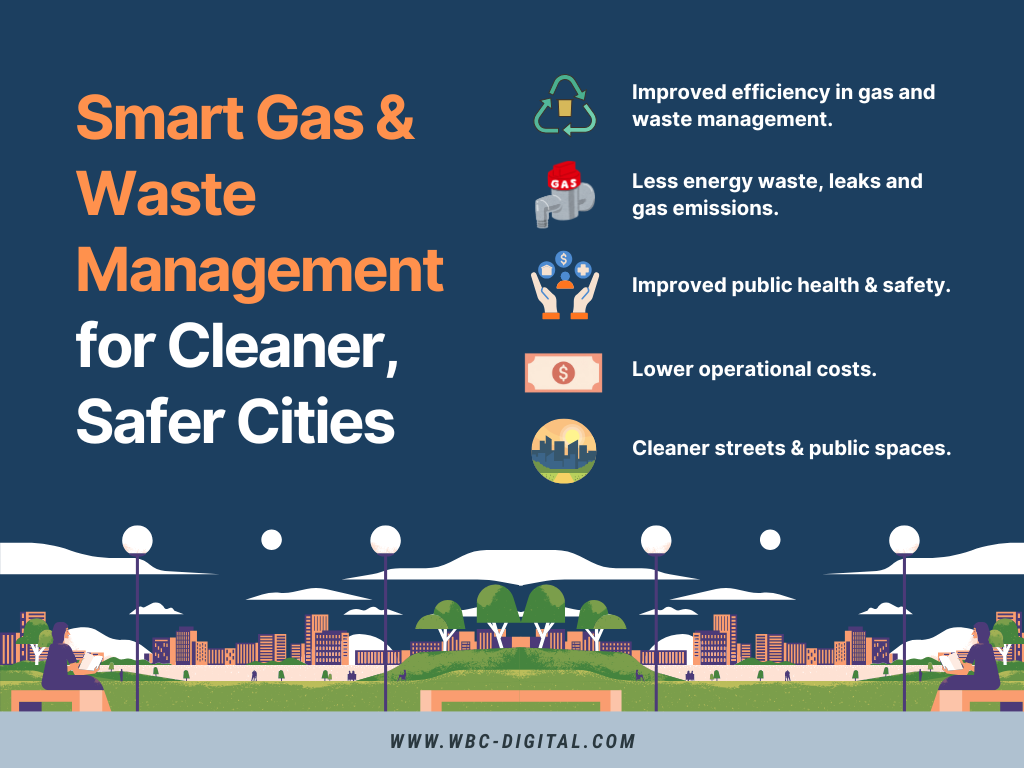
Just like smart water systems, similar technology is being used in gas pipelines as well to monitor the user consumption and detect any changes in pressure and possible leaks which can prevent resource waste, environmental hazards, and also from involving in regulatory violations. Simply put, smart gas utilities do a remarkable job in preventing accidents before they happen.
According to Reuters, there were 2600 gas pipeline leaks in the United States that have cost more than $4 billion in damages and emergency services, and claimed the lives of 122 people. Since beginning to upgrade from conventional to smart meters, the country saw a reduction in gas leakage by 30%, leading to a significant improvement in their emergency response.
When it comes to smart waste management, cities use smart bins equipped with sensors to monitor the fill levels, so AI can optimize the collection routes by alerting to empty the full bins only, and thereby preventing overflowing bins as well as reducing fuel consumption, costs & emissions. In Barcelona alone, the waste collection costs were reduced by 30% by implementing smart waste management systems.
Key outcomes:
– Improved efficiency in gas and waste management.
– Less energy waste, leaks and gas emissions.
– Improved public health and safety.
– Lower operational costs.
– Cleaner streets and public spaces.
The Future of Utility Management in Smart Cities
The future of utility management in smart cities will be driven by technologies like 5G, digital twins, edge computing, and so on. They will revolutionize how smart cities function by transforming them into a more self-learning adaptive ecosystem.
Let’s take a look at the top 3 technologies that will determine the future of utility management in smart cities.
- 5G: The Backbone of Smart Utilities
5G is becoming essential for smart utilities to handle massive amounts of data for real-time control and monitoring. Besides, every smart city will have a central network through which energy, water, gas and waste will be managed together in a single digital platform. This will eventually make large-scale deployments possible in one go, where 5G will become a necessity to support millions of connected devices and systems for real-time operations. In a nutshell, 5G will unify technologies into one real-time digital ecosystem.
- Blockchain for Decentralized Data Management
One of the biggest concerns in adapting AI & IoT in systems is data privacy and security risks, as there’s a high possibility of exposing sensitive information and cyberattacks. To combat this, governments and companies are already looking into decentralizing personal records which can be done through blockchain technology. Dubai has already taken the initiative by integrating blockchain technology to automate public services in their Dubai Smart project. Soon decentralized data management will become a necessity to build trust and enable transparency in smart city operations.
- Digital Twins: The Control Rooms of Utility Management
Imagine having a digital replica of your city’s entire utility network where you can simulate different scenarios to analyze and predict future outcomes and system failures. Well, that’s what we call digital twins. The best part is that they are continuously being updated with real-time data, as they are connected to the actual system to gather data from its sensors. They will become the new control rooms where everything will get tested and managed before real-world implementation.
Conclusion
Smart utilities are not just about technology, they are the tools that make smart cities become adaptive, efficient, and sustainable. They give the power to think ahead, act instantaneously, and grow intelligently. From energy and water to gas and waste; smart utilities waste less, save more, and serve residents better.
So the next time you come across a smart city, remember that it all starts beneath the surface with smart utilities making what looks impossible, possible.
If you are a utility company looking to adopt smart solutions using AI and IoT, you are at the right place. 🙂 Just sign up for a free consultation to discuss how we can help you transform your operations from reactive management to proactive intelligence. You can read our recent work with Hyele Ltd. to see how we built a full-scale digital platform to manage their smart urban water pipeline systems.

WBC Digital Solutions
Book a Consultation
Ready to take the next step? Schedule a consultation with our expert team.
Explore Related Topics
Other Articles

Digital Twins + AI: The Future of Smart Manufacturing and Operations
Let's explore how Digital Twins powered by AI are redefining the future of smart manufacturing.
Read more →
WBC Digital Partners with Great Wall Connect to Unlock China’s Digital Market
WBC Digital is partnering with Great Wall Connect to deliver end-to-end digital solutions for companies expanding into China.
Read more →
WBC Digital and RAND INC Join Forces to Turn Great Digital Products Into High-Growth Businesses
WBC Digital and RAND INC Limited are teaming up to combine expert software development and performance marketing.
Read more →