
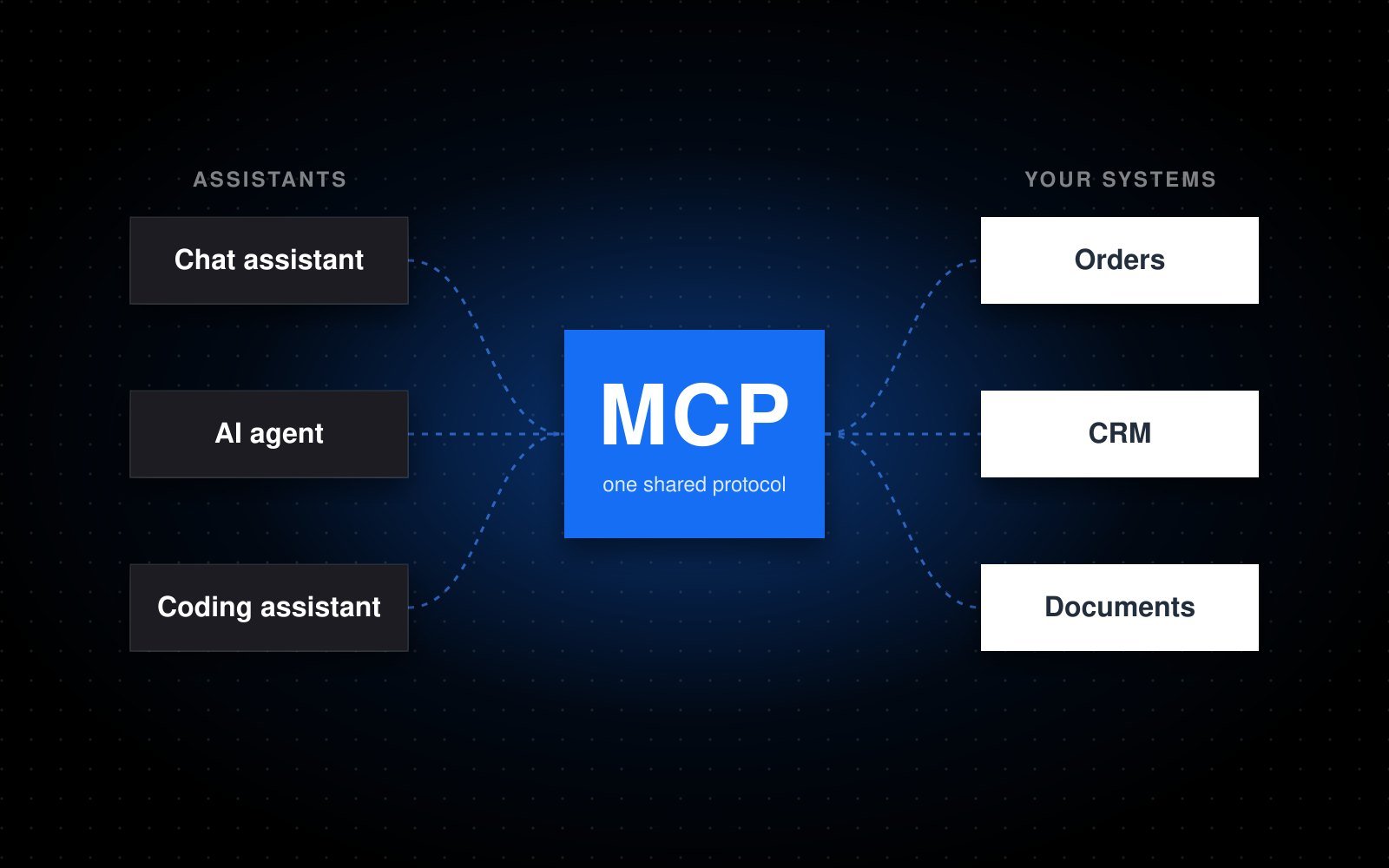
An AI assistant is only as useful as what it can reach. Ask it where an order is, what a contract says, or which customers are overdue, and it can only guess unless it can look. Until recently every connection was custom: one plugin for this chatbot, a different integration for the next. The Model Context Protocol, or MCP, replaces that with one open standard.
MCP defines how an AI application talks to a server that offers tools and data. A server for your order system might offer a get_order tool and the list of areas you deliver to. Claude, ChatGPT, Microsoft Copilot, Cursor and most other assistants and agent frameworks now support MCP, so one server works with all of them. Anthropic introduced the protocol in late 2024, and it is now governed by the Agentic AI Foundation, part of the Linux Foundation, rather than by a single vendor.
For a business, the point is that you build the connection once. Your staff can use the assistant they already have, your own agents can use the same server, and switching AI vendors later does not mean rebuilding every integration.
It is worth building a server when people already ask an assistant questions whose answers live in your systems, when several assistants or agents need the same lookups, or when you want AI to take small actions, such as drafting a quote or updating a ticket, under your controls. If you have one workflow with fixed steps, a plain API integration is often simpler. Not everything needs a protocol.
Start with a tool map: what the assistant may read, and what it may change. Narrow tools beat general ones. get_order(order_id) is far easier to secure, test and explain than a tool that runs any database query the model writes. Each tool should do one thing, with a clear name and description, because the model decides when to call it from that description alone.
Then treat the server like any API exposed to a capable but easily misled user. Sign users in through the identity provider you already run, and give each one only the access they would have anyway. Ask a person to approve anything that writes, sends or deletes. Log every call. Treat text that comes back from tools, and from servers someone else wrote, as untrusted: a document can contain instructions aimed at the model. Review community servers before you install them, as you would any dependency.
Running one is ordinary engineering. The July 2026 revision of the specification made the core protocol stateless, so a hosted server scales behind a load balancer like any web service. Version your tools, watch latency and errors, and test with the assistants your team actually uses, because each one presents tools slightly differently.
Start small: one server, three to five read-only tools, one team. Add actions with approvals once the logs show how people really use it. That is how we build MCP servers at WBC, as part of integration work that has to hold up after the demo.